

Photo by Keith Kennedy.
What is a Wildlife Garden?
A ‘wildlife garden’ is a garden that is intentionally designed and planted to support a wide range of animals including reptiles, amphibians, birds, insects and small mammals. As gardeners we can create habitats and corridors around our homes for wildlife to grow, reproduce and migrate. In my own garden in Chapel Hill, North Carolina, there are racoons, groundhogs, possums, squirrels, rabbits, voles, foxes, and even flying squirrels sharing the landscape around the house. I don’t often see these small mammals during the day but I have evidence of their presence from video recordings from around a small water fall, which has become an oasis during the hot summers. The rear garden was fenced eight years ago, so I don’t have coyote or deer in the garden, but they are in the neighborhood and I’m aware of sightings of black bears in the region.
A number of these animals can cause problems for homeowners and in particular gardeners, however we need to learn to live alongside these creatures and adapt our surroundings and expectations. I have fewer possums, squirrels and racoons frequenting the deck since I stopped using bird feeders, instead I feed the wildlife through natural means by growing plants that produce food and attract insects (see previous Garden Talk Article on Bird Feeders).
Do Deer Eat This?
Deer are a perennial problem and it’s the complaint I hear most when giving talks on gardening. The best ways to remove the impact of deer are construct a deer fence, use repellent sprays or choose plants that deer prefer not to browse. Deer have full access to my front yard, they wander through several times a day browsing the plants. During the past six years I’ve used their presence to experiment with their grazing preferences. I now grow a palette of native and a few non-native (but not invasive) plants which the deer mostly avoid. Native plants include mountain mints, native sage, woodland geranium, Jack in the pulpit, woodland phlox, irises, various goldenrods, Virginia bluebells, tickseed, sneezeweed, aromatic aster, celandine poppy, beebalm, hyssop, blue mist flower, Baptisia, Hubricht’s Bluestar, Eastern Bluestar and milkweeds, as well as a host of native grasses, sedges and ferns. The planting palette has its limitations but it’s not empty.
Why Should We Build Wildlife Gardens?
As the world becomes increasingly urbanized with around 85% of the inhabitants of western countries living in towns and cities, and by 2050 it’s expected that 75% of the world population will be living in an urban environment. As the human population continues to grow more wild areas will be used for food production, forestry, mining, constructing buildings and roads all of which reduce habitats for wildlife. In North Carolina the population rose 12% between 2010 and 2022 and it continues to grow, and we see more buildings and roads being constructed especially around population centers. Town planners should consider wildlife habitats and corridors in these urbanized landscapes and as gardeners we should play our part by creating habitats around our homes.
Gardens and natural spaces are not only seen as important to wildlife but also for human health. There are numerous studies to show that a walk in the park, sitting or working in the garden or just being outside can reduce stress and bolster the immune system. As a family we get huge pleasure welcoming the Eastern Phoebe (Sayornis phoebe) to our garden. Two broods are routinely produced, and watching the fledging’s take their first leap of faith into the air, carefully observed by their parent, is something wonderful to behold. We’ve watched the adults bring home juicy caterpillars or insects to feed the young and as a result of seeing this activity we’ve increased the range of plants that support pollinating insects as well as seeds and berries.
What does wildlife need from a garden?
Animals, whether it be reptiles, birds, mammals or insects, all have the same basic needs of water, food and shelter to live and reproduce.
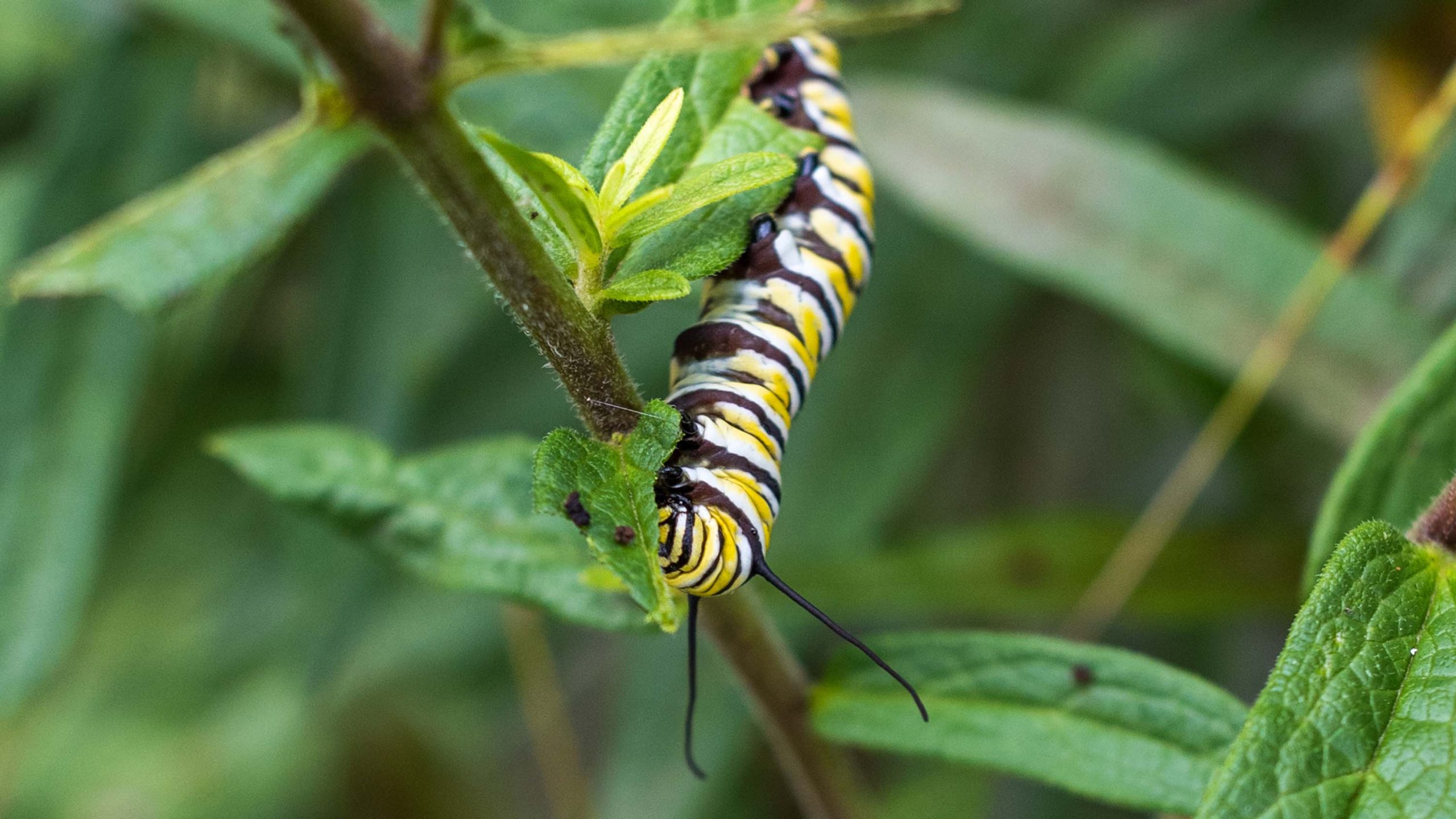
Monarch butterfly caterpillar on native milkweed, by Cathi Bodine.
Food in a Wildlife Garden
During school biology lessons, we learn about food chains and webs. At the bottom of the chain there are the primary producers, and on land these are the plants, including those we grow in our gardens. Plants capture energy from the sun and via the biochemical process of photosynthesis, which takes place in the chloroplasts most often found in leaves, they are able to make carbohydrates, such as sugars and starch.
Many of the common herbivores, such as deer, rabbits and voles will graze on plants but there is one consumer of plants that may be the most important of all…caterpillars! Birds rely on caterpillars, particularly those that become moths, to feed themselves and their young. Plants also provide food via nectar, which is full of sugar as well as pollen, which contains a wide variety of proteins, fats and carbohydrates. Many insects, not just bees and butterflies, feed on these food sources and in turn, these insects will become food for mammals, reptiles, amphibians and birds. Small mammals, such as mice and shrews may be eaten by carnivorous predators, such as snakes, coyotes, foxes, and raptors. Food webs can become imbalanced when important species are missing such as the lack of larger predators like mountain lions and wolves, which has allowed populations of deer to go unchecked.
To support a food chain in our home gardens we should grow a range of plants that can supply nectar, pollen, berries and nuts as well as herbaceous foliage for many grazing animals. As gardeners we’ve been conditioned to dislike the idea of plants being grazed by any animal especially caterpillars. However, if we want to sustain the native bird population we need to embrace insects. During the past 50 years the bird population in the US has fallen around 30%, and at the same time there has been a massive reduction in insect populations. In central North Carolina and many other parts of the country, a staggering 96% of young birds are reared on insects, and especially important are the caterpillars which are full of different proteins and fats. As the sales of bird feeders and bird feed increases throughout the US, the bird population is actually falling, as young birds cannot feed on sunflower seed or suet. The answer is to grow plants that support insects.
Many caterpillars are generalists in that they can graze from a wide range of foliage from different plant species, however there are those ‘specialist’ species that will only survive on one plant type. The most well-known insect/plant relationship is between the caterpillar of the monarch butterfly (Danaus plexippus) and plants from the milkweed subfamily (Asclepiadoideae). Milkweeds contain toxic plant metabolites known as cardenolides and most caterpillars will die if they try to consume the leaves of this plant. The caterpillar of the monarch butterfly has not only evolved resistance to these toxic substances but they also incorporate the toxic compounds into their own bodies which then become part of their defense mechanism against predators. Unfortunately, as milkweeds disappear from wild spaces the monarch butterfly population is reducing, it is therefore critical that we grow milkweeds in our garden or on our patios, decks and balconies to support this iconic group of butterflies. A National Wildlife Federation (NWF) programme ‘Interstate 35: Monarch Butterfly Highway’ has been set up to encourage the public, particularly schools, to plant milkweed to help protect and save these iconic butterflies.
Once flowers are fertilised they go to seed and can form fruits such as berries and nuts, these are rich sources of food for small mammals and birds in the winter months. While sunflower and coneflower seeds support a wealth of goldfinches and other birds.
When choosing plants for the garden it is important to consider a succession of flowering from spring through to fall, so that food is available for wildlife throughout the season. In North Carolina the blooming time of many flowers can be short due to summer drought, the heat and humidity. Plants such as Baptisia spp. are persistent and can thrive for decades in the same space but may bloom for under two weeks in June. Other plants like Gaura and Anise hyssop can bloom from early summer into the Fall and attract many native bees, however these same plants don’t often persist from year to year, and as such should be treated as annuals. I find the same with sundrops (Oenothera fruticosa) , the blue mist flower (Conoclinium coelestinum), a number of Penstemon spp., Lobelia spp. and Liatris spp., although when these plants are growing in the suitable spot they can set seed, germinate and colonize the area.

Millstone water feature in the Wildlife Garden, by Cathi Bodine.
Water in a Wildlife Garden
Water is essential for all life, and in all wildlife gardens there must be a source of water. This does not have to be a pond or a waterfall, a small recirculating water feature would suffice. In the Blomquist Backyard Garden an old millstone has been repurposed as a recirculating water feature and small water bowls have been added containing pickerel weed (Pontederia cordata), native water lilies and irises. Shallow bird baths would also be valuable during hot summers, but it is essential to add water when it doesn’t rain. Damp muddy areas in the garden are valuable for salamanders to shelter or places for the threatened Eastern box turtle (Terrapene carolina carolina) to hunker down during the hot weather. Butterflies are often seen on muddy pools or on wet paths carrying out ‘puddling’, where they obtain water and essential nutrients which they need to grow and reproduce. This can be replicated in the garden by using a shallow bowl containing moist mud or a wet mixture of sand and compost. Even bees drink water from small ponds or from the morning dew on plants.
Shelter in a Wildlife Garden
Most of living organisms need a ‘roof’ for shelter from bad weather or predators. For wildlife in the garden these ‘roofs’ can be evergreen shrubbery, dead trees, wood piles, walls or boulders. Rabbits, possums and racoons can be found living in shallow hollows, under decks or in amongst wood piles protected by evergreen shrubbery. Reptiles and amphibians often hide between the stones of walls and boulders or under leaves in the autumn. Woodpeckers can create cavities in dead trees, these snags can also be homes to bats and flying squirrels. It has been demonstrated that some of the most biodiverse gardens are not the wildest in appearance but those that offer the largest diversity of niches, where animals can occupy
Leave the Leaves
Many more towns in North Carolina have stopped collecting leaves from neighborhoods. During the last HOA meeting for my neighborhood in Chapel Hill we actively discussed this subject, and there were several differing opinions from people annoyed that the leaves would not be removed to those fully embracing this new approach.
We have to respect that people have different gardening aesthetics, and there are people who like to see a very tidy yard, where tidy means removal of all the fallen leaves from the various native deciduous trees around their homes and replacing these with imported hardwood mulch. This type of mulch does break down over time and will release some nutrients back into the soil which will help with soil structure. Mulch can also suppress weeds and help retain moisture in the soil. However, if the mulch is put out too thickly it can actually stop water from getting into the soil and in fact reduce rain water availability to the tree roots. It is also possible that fungal pathogens, such as the honey fungus (Armillaria), can be brought into the garden via mulch.
The best approach is for people to observe nature and look to the natural woodlands. Here leaves fall to the ground, decay and within a few months the nutrients are released and utilised by soil microflora, trees, and shrubs – this is a natural cycle that has been successful for millennia. The quality of the nutrients from leaves is much better than the nutrients from hardwood mulch – which is highly lignified. In addition to the better nutrient supply to the ecosystem, the leaf litter creates habitats and shelter for wildlife. Insects overwinter in the leaf litter, and the various forms of fungi and bacteria degrade the leaves through enzyme activity utilise these nutrients, moisture and oxygen to carry out these essential biochemical processes. Birds search for their food amongst the leaf layer in the winter months finding overwintering insects and for the hawks and owls they can unearth small mammals. Ecologically speaking ‘leaving the leaves’ is better approach for the ecosystem than their removal and replacement with hardwood mulch.
Even if it can be argued that leaves are substantially better than mulch for the ecosystem there is still the different aesthetics, as well as the safety aspect of the leaves being left on footpaths and roads in the neighborhoods. I prefer to see leaves under trees rather than mulch, it looks more natural. It may take time but as the majority of people leaving the leaves others will follow suit. On my own property I’ve always kept my leaves especially where they fall under the trees or on some of my flower beds. However, I remove the leaves from my paths, steps, patio and walking areas, including lawns and add them to the wooded areas or I mix them with my vegetable waste in my compost maker, which is used in my vegetable plots.

A tranquil moment in the Blomquist Wildlife Garden, by Keith Kennedy.
The Human Aspect of a Wildlife Garden:
A ‘backyard wildlife garden’ is not the wild, it’s a garden, created by humans to support wildlife. Hence such gardens should not only be attractive to a wide array of animals but they should also be attractive to us. At the simplest level we want to encourage our neighbours and Home Owners Associations (HOAs) to ‘garden for wildlife’ and to create habitats and corridors for animals to grow, reproduce and migrate. Traditionally wildlife gardens have acquired a poor reputation for looking unattractive and uncared for, but they don’t have to look messy to function as a wildlife habitat.