
The centerpiece of the Garden Gateway renovation and expansion project is the new Barnes Welcome Center, which serves as a focal point to orient guests and provide upgraded amenities for a world-class botanical garden experience.

The Doris Duke Center and visitor parking before the Garden Gateway project

Architectural rendering of the new Barnes Welcome Center and renovated Doris Duke Center, courtesy of Duda Paine Architects
Duke Gardens is a place where Duke University opens its doors to Durham and the world, and in recent years, the number of visitors has risen dramatically. Mary Eubanks, a retired biology professor who has been involved with the Gardens for more than 30 years, has noticed the changes. “We once were very local, a university garden with mostly Durham people. Now we’ve grown to more than 600,000 visitors a year. People come from all over the world, and the Gardens have become a public resource, not just a university treasure,” she said.
As the popularity of Duke Gardens has grown, so has the need for more space and facilities to support visitors.
The Garden Gateway project, a transformational renovation and expansion project (constructed from February 2025 to April 2026) is designed to enrich the experience for all visitors and to accommodate the garden’s dramatic growth in the past decade.
“The Garden Gateway project is a forward-looking solution that reaffirms Duke Gardens as a beautiful world-class destination that inspires transformative learning, promotes wellness and builds community,” said Duke Gardens executive director Bill LeFevre. “We have listened to students, faculty, alumni and the community to envision how the Gardens can evolve to better meet their needs and retain the qualities that make it a special place.”
The Barnes Welcome Center
The centerpiece of the project is the Barnes Welcome Center, which creates a true entry point to the Gardens, including a dedicated visitor lobby with maps and guides to point out seasonal highlights and answer questions. An enclosed gallery space, classrooms and expanded outdoor seating areas support a wide range of educational programs and community events, including visits from area school groups and Duke University classes. A new designated drop-off spot for buses and more gentle grading on walkways improve safety for all pedestrians.
“For an organism to live, it has to grow,” says Len Thomas, a longtime Duke Gardens volunteer. “The Garden Gateway Project recognizes this—it’s about making the Gardens an even better asset for the community through growth that’s tasteful and respectful.”


The Barnes Welcome Center creates a true entry point to the Gardens, including the Gravatt Family Lobby, where visitors can speak with staff and volunteers as well as get maps and resources enrich their Gardens visit.
One of the much-anticipated additions at the Welcome Center is a café with expanded space for indoor and outdoor gatherings. It’s a place where the university, the community and visitors from across the globe can pause to experience peace and beauty.
“For families at Duke Health, the Gardens are a place to step away from the stress of hospital life, even if just for a moment,” says Valerie Sabol, RN, PhD, Clinical Professor and Chair for the Division of Healthcare in Adult Populations at Duke University School of Nursing. “The Gardens really represent the intersection between the environment and human health.”
For Dio Parker, working at Duke Gardens has been a transformative experience. “I was a very indoors kid, and after quarantine, it took me a while to adjust to being outside all day,” says Parker, who began at the Gardens through the Rising Stars Internship Program and later became a camp counselor. “But it was worth it. Duke Gardens is such a beautiful place, and working there gave me a deeper appreciation for nature than I’d ever had before.”

Visitors can connect with nature and each other in the outdoor courtyard of the Barnes Welcome Center

The Barnes Welcome Center includes the new Gardens Cafe in the Reiffel-Kefer Cafe Pavilion
The Barnes Welcome Center will also expand opportunities for education. “Duke Gardens is one of those spaces where our students can be part of something bigger,” says Gregory Lewis, who works with students with autism as Occupational Course of Studies coordinator for Durham School of the Arts. “They contribute to the community and are seen for their abilities, not their disabilities.”
With the new Welcome Center at the heart of the Garden Gateway Project, Duke Gardens will continue to grow, while ensuring this special place remains one where the world is always welcome.

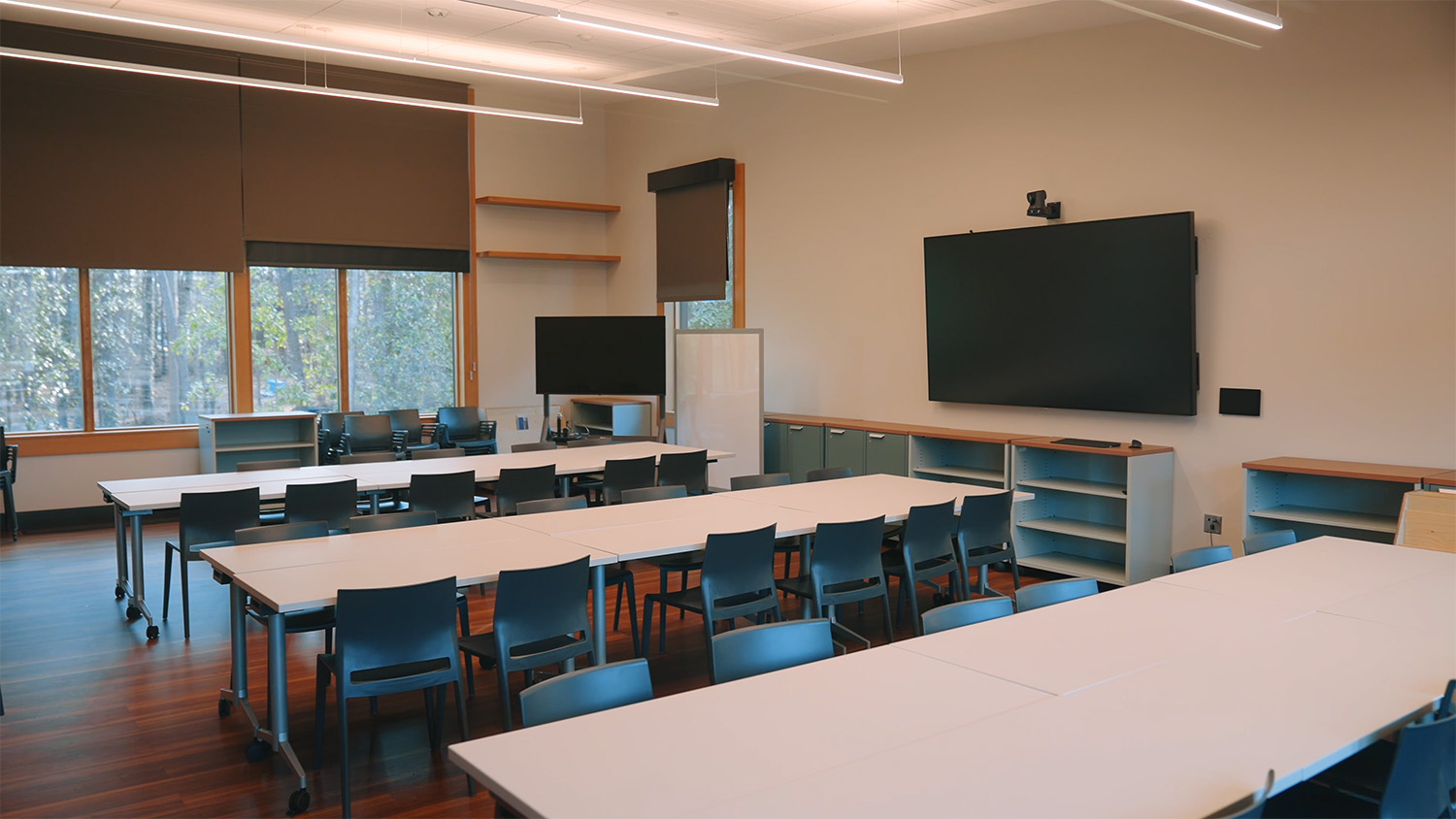

The Eleanor DeVries Gallery (left) and Pelham-Cullen Classroom (right) in the Barnes Welcome Center
Welcome to the Welcome Center
Get to know the Barnes Welcome Center through the floorplan, renderings and video of the newly constructed spaces below.

A Special Thank You to the Barnes Family Foundation
The Durham-based Barnes Family Foundation was instrumental in bringing the Garden Gateway project to life with a transformational gift that names the Barnes Welcome Center.
“We are so grateful to the Barnes family for their leadership in the Garden Gateway project,” said Duke University president Vincent E. Price. “Their generosity will help shape a welcoming and engaging setting that enriches each visitor’s experience and expands opportunities to discover the beauty of the Duke Gardens.”
The $30 million Garden Gateway project was inspired by a vision of enhancing Duke Gardens as a vibrant hub for students, the university and the public, while retaining the character that has made it one of the region’s most beloved places. It was funded by private contributions from the Barnes Family Foundation, The Duke Endowment and generous gifts from Duke alumni, parents, and community members.
“The Barnes family was instrumental in updating our facilities to provide an optimal experience for everyone,” said William M. LeFevre, executive director of Duke Gardens. “We are delighted that the new welcome center will bear the family’s name as we realize the completion of this project, which will provide a richer experience for both the Duke and Durham communities.”
The Barnes Welcome Center honors Barnes family patriarch and foundation founder Marvin Barnes ’59, P’95. While a student at Duke, Barnes played trombone in the marching band, ran on Al Buehler’s second cross country team, was a cheerleader, and joined Phi Kappa Sigma fraternity. Barnes, a Durham businessman, also chaired the Duke-Durham Campaign, raising funds to support the university’s work in the neighborhoods and schools close to campus.
“It speaks volumes of our beloved Duke University, that this fine institution of higher learning has a publicly welcoming outdoor space,” said Lee Barnes M.B.A.’95, president of the Barnes Family Foundation. “The foundation supports keeping this space public, accessible, and welcoming for everyone. This gift is a part of the vision that Duke and the Barnes Family Foundation share. We are humbled that the part we played made it possible for the wonderful entryway and building at Duke Gardens to be completed.”
The mission of the Barnes Family Foundation is to support and reinforce the foundational structure of the individual. It helps hyper-local and hyper-public nonprofit organizations that educate, promote, and refine the knowledge, skills and abilities in order to help individuals attain the agency and liberty for a practical, productive, and fulfilling life.

Representatives from the Barnes Family Foundation (left to right): Trey Barnes, Christy Barnes, Lee Barnes, Cynthia Barnes, Marvin Lee Barnes, Blair Barnes Morgan and Richard Wood Morgan.
Growing Sustainably & Responsibly
Sustainability is at the heart of the Garden Gateway project. The new construction is one of the first campus building projects to adhere to Duke University’s High Performance Building Framework, which takes a holistic view of green building by outlining an improved process for planning, a rigorous sustainable design standard and a new tracking and rating system to examine how facilities perform in the long term. Learn More >
Questions?
Please contact us at gardens@duke.edu.